
Through Dust and Distance Chapter 12
The Miles That Change a Man
This is the seventeenth installment in a serialized story about Will Sturgis, a young hand looking for wages and maybe a bit of purpose. He joins a northbound cattle drive and learns fast that the trail is equal parts sweat, dust, danger and unexpected grace. If you like Westerns with heart and grit, saddle up. Will’s got a long way to ride.
The first one is free, but the rest will be under the paid subscription. I have a sale going on now where you can get a permanent 75% discount for annual subscriptions now. Sign up here: Annual Subscription Sale 75% off!
I hope you join Will on his ride north.
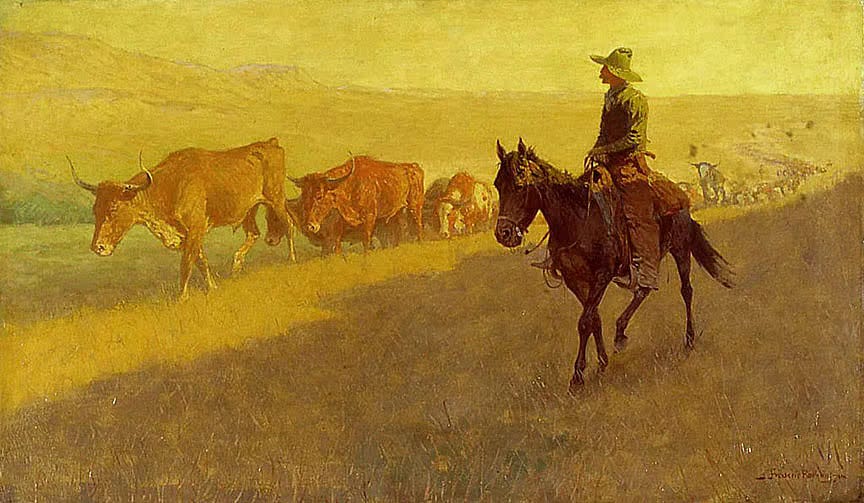
The fire had nearly burned out, only a faint red ember remained. The camp was quieter than normal.
Will wondered if Tucker had slept any. He sat on an overturned bucket, elbows on his knees, just staring at the ground.
Will didn’t have it in him to bother Tucker, so he went to saddle the dun in the half-light. The world seemed muffled this morning. Nobody was talking and the herd usually grumbled at dawn, but not today.
Cole broke the quiet, stomping past with his saddle over his shoulder, muttering something. But that was nothing new. Cole woke up angry most days.
Dutch was rubbing a stiff knee as he checked the wagon canvas and the hitching. Clara moved to the firebox, trying to coax it alive, jaw set in a stubborn line.
When the coffee boiled and she started handing out cups, Will stepped forward without thinking. She looked up but didn’t say a word, just pressed the cup into his hands.
The coffee was half-burned, bitter as dirt, but it hit him right. The first swallow pushed warmth into those empty spots grief had carved out overnight.
The men were breaking camp slowly, nobody talking more than needed. Holt sat beside his bedroll, going through the last of his gear. The pistols lay there beside him. He picked up the first one and checked the cylinder. Then he holstered it. The second followed.
The trail had teeth. Benji was raw proof of that.
Holt stood and pulled on his gun belt. The other men always wore their pistols, but Holt wearing his felt serious, like the trail was different now, and not in a good way.
Clara was packing flour tins back into the cook box when she glanced over. Holt had just stood, the pistols resting on his hips.
Her hands stopped moving on the tin lid. She didn’t stare long, but her expression changed to something softer. Then she went back to work.
Cutter said, “Mount up. We got a long push.”
Will half expected him to say something more about Benji. Apparently, that was not going to happen, so he swung into the saddle, the dun shifting under him like it was relieved to be moving. The sun edged the horizon as they rode out.
The prairie stretched wide, a gentle swell of land running north. The day was warming quick, even before the sun cleared the ridge.
Up ahead, Tucker rode point beside Cole, but the posture gave him away. His seat was wrong, reins slack, like he was letting the dun find its own way because his mind was elsewhere. Cole barked at him, sharp and too loud, but Tucker barely reacted.
Tucker needed steadying, and Will was not close enough to give it. All he could do was keep the cattle where they needed to be and hope the trail didn’t ask more than Tucker had to give.
He finally glanced back. His eyes found Will. He looked lost.
Will tipped his chin once, You’re all right.
Tucker straightened a little.
To their good fortune, the herd fell into an easy gait, hooves thumping the ground in a pattern Will’s body answered. He didn’t think about it, just slipped into the same pace. Somewhere to the rear, Dutch was cussing at a mule that wasn’t pulling its share.
Clara laughed.
That sound broke through the gloom that was weighing everybody down.
By midday the sun burned off the shadows but not the ache. Ortega swung by, giving Will one of those looks that said he saw more than Will wanted.
“You’re workin’ double,” Ortega said.
“He needs it,” Will answered, motioning toward Tucker.
“Maybe.” Ortega said. “But don’t let yourself burn out doin’ another man’s thinkin’.”
“I ain’t tired.”
Ortega snorted. “We are all tired. That ain’t the question.”
Before Will could respond, a steer attempted to drift out of the line, and Ortega peeled off to redirect it.
They rode until Cutter raised his hand, signaling a short halt. Men dismounted slow. Clara passed around cold biscuits and strips of jerky. Cole took his portion with a grunt, barely looking at anyone. He had been simmering since camp broke.
Holt stayed seated on the bay and scanned the horizon, like he was waiting for things to break. He didn’t seem nervous but was always on that edge of wary. What was it like to live like that? Will was glad he didn’t feel that weight.
When Cutter swung back into the saddle, Will did too, feeling the drag in his shoulders. The afternoon heat came down on them like someone had laid a stove lid on the sky. Sweat gathered inside his shirt. The dun twitched at flies.
They pushed on.
The sun began its slow drop westward. Shadows lengthened behind the herd, stretching long, like they were trying to follow them out of Indian Territory. Cutter signaled a slow-down and let the cattle ease into a more relaxed walk. Even he looked worn to the grain. The whole crew felt rubbed down to their quietest selves.
When they finally stopped to let the cattle graze on a flatter stretch of grass, Clara hopped down from the wagon tongue and started pulling the cook box open, fetching flour and tins with that brisk, automatic efficiency of hers.
Will moved to water the dun at a seep in the shallow draw. Holt was already there watering the bay. Will made his decision. The question had been gnawing at him for weeks, crawling behind his ribs, refusing to give him any peace.
“Holt?”
Holt didn’t look up right away, just finished checking the hind leg of the bay, pressed once on the fetlock, nodded, and let the leg down gentle. Only then did he straighten.
“What is it, Sturgis?”
Will worked his fingers around the leather strap, trying to keep his voice level. “I need to ask you something. If it’s out of line, just tell me and I’ll shut up.”
Holt lifted one eyebrow. That was permission enough.
“Why’d you fight for the South?”
He wasn’t accusing Holt of anything. It was just the kind of question where he wanted the world to make more sense than it did.
Holt let out a slow breath through his nose. “Because by the time the war came down my way, the bluecoats weren’t liberators.”
“What do you mean?”
Holt pulled out a brush, knocked dust off it with his hand, and set it back in the pack again.
“They burned our crops first year,” he said. “Said they were takin’ the South’s food, but they didn’t leave us any. My ma and little sister hid in the root cellar while they stripped the place.”
“My baby sister didn’t make it through the winter,” Holt said, matter-of-fact, as if the words had been sanded smooth from too much handling. “We had nothin’ left to feed her.”
Something caught in Will’s throat, but he found the words. “I’m sorry.”
Holt nodded. “They came back the next year. Didn’t find anything worth stealin’ by then, so they burned the barn and the house.”
It was worse than Will had imagined, all of it. “I didn’t know.”
“Folks talk like the war was clean lines,” Holt said. “Right and wrong. Good and bad. But it wasn’t. Up north, they talk like every man wearin’ gray was fightin’ for slavery. Where I come from, they didn’t have much good to say about men wearin’ blue. Not after the war ran through us the way it did. Truth sits somewhere ugly in between.”
He rested his hand on the bay’s neck. The horse leaned into him.
“I fought because the men who killed my sister wore blue,” Holt said. “And because I was twenty and too angry for sense. That’s the whole of it.”
A few feet away, the scrape of Cole’s whetstone stopped.
Men were listening.
Will swallowed. “You don’t talk about it.”
“Can’t change it now,” Holt said. “And talk don’t fix dead folks.”
He turned then, really looked at Will.
“But I don’t hold the whole north responsible for what three men did. You’re proof enough of that.”
Heat went up Will’s neck, something like shame and gratitude both. “Sorry about your family, but I ain’t north or south. I’m from Texas.”
Holt said, “And better for it.”
From near the cook fire, Cole said, “Listen to you two. Makes me sick. You expect pity for that?”
Holt didn’t even turn his head. His voice stayed level. “No. I expect men to carry their own scars without swingin’ them at others.”
Cole muttered something, but the edge had dulled.
No one took his side.
Holt pulled out his brush again, put it to work with the horse.
“Truth is,” Holt said, “I learned I had a talent for killing folks. Didn’t want it. Don’t want it now. But a man don’t get to unlearn the things war taught him.”
Will said, “You don’t seem like that man now.”
“I’m tryin’ not to be.”
Will nodded. “I believe you.”
Holt studied him for a long second, as if measuring the weight of that belief. Then he touched his hat brim and grabbed the bay’s reins and led him to the remuda.
Will watched him go, not sure how to feel about all of that.
Cole muttered something under his breath.
When Will came back to camp, he saw Holt standing near Clara’s little circle of work, hat in hand.
Clara was rolling a length of bandage in her hands, even though she had a basket full of them. Holt shifted his weight once before speaking.
“You heard,” he said.
Clara said, “Most of it.”
“I meant to keep that to Will.”
“I know.” She stopped rolling the bandage and finally met his eyes, steady as a fresh-cut board. “But you told Will you were good at killing people.”
“I did.”
“That scares me,” she said.
“I ain’t proud of it.”
“You’re trying,” she said. “I see that.”
“Some days I feel like I’m patchin’ a leaky roof in a rainstorm,” Holt said.
Clara smiled. “I know the feeling.”
“I ain’t the man I was then.”
“I want to believe that,” Clara said. She looked like she wanted to say more but just went back to working the bandages.
Holt looked at her for a few more moments then said, “You take all the time you need. I won’t push.”
He tipped his hat and walked off with slow, even steps.
Will wasn’t trying to listen, but he wasn’t far away, and her face was turned just enough that he caught the ache settling behind her calm. It made something in his chest tug sideways.
He thought about walking over, but she wasn’t done being approached for the evening, someone else had already readied himself for that role.
Cole stepped out of the shadow behind the wagon like he had been waiting for his moment. His boots hit the ground hard. Clara noticed him the way you notice a storm cloud you hope will drift past.
“You stay away from him,” Cole said.
Clara stood up straighter. “Don’t start.”
“I ain’t startin’. I’m tellin’ you.” His voice was clipped, brittle. “Holt ain’t safe.”
“Safe?” Clara said. “You think any of us out here are safe?”
“You know what I mean.” Cole jabbed a finger toward where Holt had gone. “You heard him. A man says he was good at killing, you run from that.”
Clara shook her head. “Holt is trying to be better than the war made him.”
Cole laughed. “You’re blind.”
“No.” Clara stepped into his space. “I’m paying attention. You should try it.”
Cole blinked in surprise. He wasn’t used to anyone pushing back, especially not her.
“You think he’s good enough for you?”
Clara stared straight at him. “That is none of your business, Ephraim Cole.”
Cole swallowed. Brief hurt that flashed before the anger flooded back.
Clara said, “Holt is fighting to be better. Hate is eating you alive. You best mind your own business.”
She brushed past him, skirts whispering against dry grass, and headed toward Cutter’s kettle.
Cole stood frozen.
Will saw Holt out of the corner of his eye. The man hadn’t moved, still lying on his bedroll, but his eyes were open and bright in the failing light. He’d heard every word. And he didn’t get up or react. He just lay there, staring up into the dead sky.
The sun dragged itself lower. Men gathered around the fire for food. Will took his plate and sat near the edge of the firelight. Tucker slid down beside him a moment later.
They ate without words. Tucker seemed to need the quiet.
Quiet had its own magic. It didn’t leave any bruises behind.
The fire burned low, throwing a flickering orange over Tucker. It made him look older, brow shadowed, a hard line where worry had carved him deeper.
Will nudged his shoulder lightly. “You eat anything?”
“A little.” Tucker poked at his plate with the end of his fork. “Not much hungry.”
“I get it,” Will said.
Tucker nodded without looking up. “Feels like…” He paused, chewing the inside of his cheek. “Feels like maybe it should’ve been me out there instead of Benji.”
Will set his own plate down. “Don’t say that.”
“Why not? I froze. I know it. I didn’t do a damned thing.”
“You were scared,” Will said. “So was everyone. Scared don’t decide who lives.”
Tucker swallowed, shoulders drawing in. “Benji didn’t freeze.”
Will felt that word stab him, a place not healed yet. “And it got him killed. We all did what we were able to. Nothing we do now is gonna change anything.”
Tucker kicked a pebble toward the fire. “Cole says—”
“I don’t give a dang what Cole says.”
Tucker looked over, startled.
Will didn’t soften. “You hear me? A man like Cole tells you you failed, he’s tryin’ to keep his own ghosts out of his boots. Don’t let him put ’em in yours.”
Tucker stared into the flames. “Sometimes I don’t know who to listen to.”
“Then listen to Cutter,” Will said. “And Ortega. And… well, Holt, when he talks. And Clara.” He nudged Tucker again. “And maybe me.”
Tucker gave a short huff of a laugh. “Yeah. Maybe you.”
Will saw bits of Sam in him, but Sam was never this hesitant.
Tucker finally took a bite.
Will picked up his plate and finished eating. All that stuff about freezing up… none of what Tucker said was wrong. Will felt it too. Why didn’t he do more? He just wanted to stop thinking, but he figured that wasn’t going to happen.