
Through Dust and Distance Chapter 15 Part 1
Abilene
This is the twentieth installment in a serialized story about Will Sturgis, a young hand looking for wages and maybe a bit of purpose. He joins a northbound cattle drive and learns fast that the trail is equal parts sweat, dust, danger and unexpected grace. If you like Westerns with heart and grit, saddle up. Will’s got a long way to ride.
The first one is free, but the rest will be under the paid subscription. I have a sale going on now where you can get a permanent 75% discount for annual subscriptions now. Sign up here: Annual Subscription Sale 75% off!
I hope you join Will on his ride north.
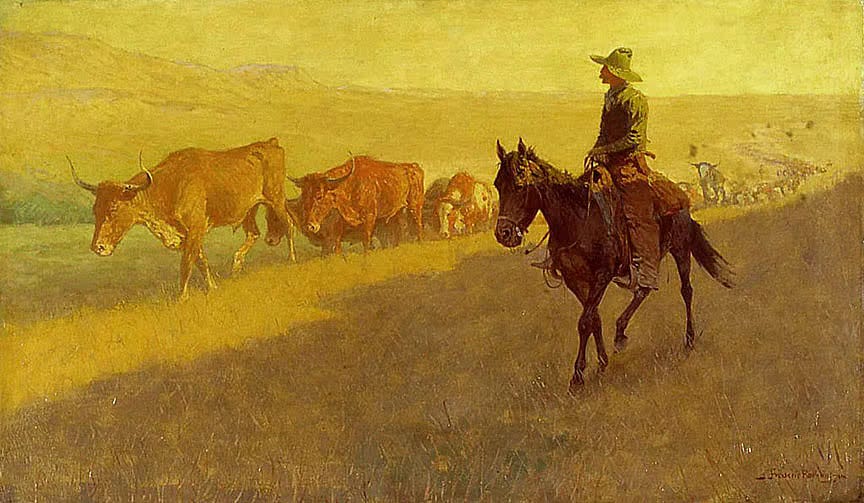
Late in the afternoon, Cutter rode up onto a low rise and looked north, “See that?”
Will nudged the pinto up beside him.
Far off, a dark line of roofs and fences, smoke rising straight as fence rails.
Abilene.
They had brought the herd this far. Through fire, rustlers, storms, and nights that stripped a man down to bone. His heart swelled.
And behind the town, something long and gleaming caught the sun.
He squinted at those long metal shapes but they made no sense. The huge boxes looked too big to move.
There would be time to figure out what he was looking at once they got closer.
“Kansas,” Tucker said. “We made it.”
“Yeah,” Will said. “We did.”
When he turned back, Will caught sight of Cole staring at the town like it had done him a personal wrong. Will didn’t like the look of it. Holt saw it too. He kept riding the edge of the herd, not crowding Cole.
“We’re close,” Cutter said. “Keep your heads. Town’s got more ways to hurt you than the trail ever did.”
Will believed him.
They hit the first outskirts by evening.
The land broke into fenced pastures and churned mud. A sign was nailed to a split-rail post where the road narrowed.
NO FIREARMS WITHIN CITY LIMITS. CHECK ALL WEAPONS. BY ORDER OF CITY COUNCIL.
Tucker said, “They mean that?”
Amos grunted. “The marshal will. Hickok used to run this place. Folks here take law with both hands.”
Isaiah and Vega brought the remuda along the fence line, horses bunching at the new smells, coal smoke, fresh-cut lumber stacked thick. Isaiah’s voice rose, steadying the skittish mounts. Vega kept circling to catch two yearlings trying to edge off toward the stockyards.
They passed another of the warning signs at a saloon doorway, and then a third nailed to a general store wall.
Abilene wasn’t playing around.
Before they reached the busier stretch, Holt guided the gray over to a small shed beside the marshal’s office. A bored-looking clerk sat behind a narrow counter.
Holt unbuckled his gun belt, set both pistols on the counter, and said, “Keep ’em safe till I’m done.”
“Yes, sir,” the clerk replied, sliding the belt into a cubby with a tag.
They all took their turns giving up their pistols.
The air smelled wrong compared to the trail. Coal smoke drifted between the buildings. Horse sweat and manure baked in the street. Somewhere down toward the slaughter yards came the coppery stink of blood and butcher waste.
The sound was also new and big and confusing, wagons rattling, men shouting, somebody laughing too loud, a piano playing, hammers ringing on iron. And threaded through all of it was a long, piercing cry he’d only ever heard described in stories. Will froze. That had to be the train, that shrill scream cutting through the air. It crawled along his spine, strange and enormous, a sound too big to fit in any world he knew.
Abilene rose up, a string of false-front buildings crowding the main street.
Will had heard talk about iron rails and huge boxes that moved on them but had never seen any of it. There, down a shallow slope, long iron lines crisscrossed. And sitting on those lines were black iron beasts, big as barns, huffing steam like they were angry. The whole thing looking like some wild contraption men had dared to build before thinking it through.
Cutter led them down toward the pens. Fences, posts, alleys, all designed to turn longhorns into countable rows and then into numbers on a page.
“Ortega, Amos,” Cutter called. “Help ’em sort. Will, you stick on left. Keep ’em movin’.”
Red and Holt took opposite shoulders in the sorting alleys, swinging their hats and easing steers forward with clean, practiced angles. Between the two of them, the lead bunch flowed like water.
Tom Reed handled the tail as always, turning back the ornery ones, letting the good movers through. The dust in the alleys draped him gray as a ghost, but he kept the rear gate from clogging once.
Off to the side, Isaiah and Vega peeled the remuda away toward the livery corrals, the string uneasy in the crush of noise. Isaiah walked on foot for part of it, hand on the halter of a jumpy dun mare.
The next hours were work, plain and simple.
They eased the herd through a maze of chutes and gates, splitting them out, shoving them along with whoops and hat waves and the periodic smack of a rope-end on hide. The buyers’ men moved among them.
Will’s world narrowed again in a way that comforted him. He watched horns and gaps and the angle of each steer’s shoulder. He listened for Cutter’s calls and Ortega’s whistles. Town noise faded to a dull buzz behind it all.
By the time the last of Cutter’s herd stood packed in the buyer’s pen, Will’s shirt clung damp to his back and his throat felt like he’d swallowed a yard of rope.
Cutter rode up to the buyer under a rough-planked awning. They talked numbers awhile. Will couldn’t hear the words, only watched the way the buyer’s hands moved, and Cutter’s face stayed steady. A clerk with ink-stained fingers scribbled in a ledger.
At last, Cutter came back, tucking a folder into his vest, along with a saddle bag that he draped over his shoulder.
“We’re penned and paid,” Cutter said. “Head count came out fair.”
Quiet satisfaction moved through the men, smiles and some spilled laughter. He thought about Benji, not getting his share.
Cole had stayed through the last of the penning, face set, movements jerky. The minute the buyer’s man had snapped the final gate shut, Cole had swung down, thrown his reins at a rail boy.
Cutter turned to face him.
“I’ll take what’s owed and be on my way,” Cole said.
“You will,” Cutter said. He didn’t sound angry. Just done.
He pulled a smaller roll of bills from inside his vest, counted out bills into his palm. “There. Trail pay and bonus on delivery. This is a good chunk. We’ll settle up the rest in the morning.”
Cole closed his fingers around the money like it might run.
“You aim to ride on with us a while?” Cutter asked. It was the closest thing to an olive branch Will had ever heard from him.
“No,” Cole said. “Think I’ve had my fill of your outfit.”
Tucker shifted in his saddle. Will felt the movement, though he didn’t look away from Cole.
“We’re done here,” Cutter said quietly. “Where you go now is your own business.”
Cole’s gaze flicked once toward Holt, once toward Will, a quick cut like a knife. He gave a tight, humorless smile.
“Yeah. Reckon it is.” Cole spit tobacco juice near Cutter’s boot, not so near as to set Cutter off though, then he turned and climbed toward town, shoulders stiff, hat brim hiding his eyes.
Will was unsure how he felt about all of it. Cole was really asking for it.
Clara’s voice came from the wagon. “He’s not coming back, is he?”
Will didn’t answer at first. He didn’t know which way that wish ran inside him, then he said, “He ain’t got all his pay yet. We’ll see him in the morning most likely.”
“Listen up,” Cutter said, once the herd was fully in the buyer’s hands and the pens closed behind them. The men gathered near the wagon, dust-caked, eyes already wandering toward the noise and color up the hill.
“You earned yourselves a night. You got the rest of your trail pay coming after I settle with the bank. You want whiskey, cards, women, I can’t stop you. But you start fights, knife someone, or wake up in a cell, you’re on your own.”
Amos cleared his throat.
Cutter sighed. “Mostly on your own,” he amended. “I’ll get you out once. Just once. You make me do it again, you walk home.”
That drew laughter, the kind that didn’t quite scrub off the edge of truth.
He gave them each part of their share for the evening. “Try not to blow it all tonight.”
He looked at Clara. “You and Dutch see to the wagon, the rest of the supplies. We’ll need to provision for the ride home.”
Clara nodded once. “Yes, Mr. Cutter.”
“And Holt,” Cutter added. “You walk with her when she goes into town.”
“Yes, sir,” Holt said.
He didn’t puff up at the order. Didn’t shrug it off either. Just accepted it like any other job.
Red pocketed his money with a grunt that sounded like relief. Tom counted his twice, folded it careful, and tucked it deep in his vest.
Luis and Isaiah compared their pay and headed off together toward the quieter end of town, both men too sensible for trouble.
The others scattered after that, like marbles spilling from a jar.
Amos grabbed Will by the arm before he could get far. “Come on. You and Tucker need boots that ain’t full of holes, and I aim to see you buy something sensible.”
Tucker snorted. “You’re a regular saint, Amos.”
“Damn right,” Amos said. “Let’s move.”
The main street rolled out in front of them, deep ruts churned by wagons. Saloons lined both sides, piano noise spilling out, men shouting over everything. Signs promised all manner of things. GOOD WHISKEY, CLEAN BEDS, HOT BATHS. Will doubted any of that was true.
“Guard your pockets,” Amos muttered. “Town like this, money has a way of leaving on its own.”
The three of them walked toward the center of town. It was almost too much to imagine, but there it was right in front of him. He had been to Fort Worth once and thought it about as big as the world got. Abilene made that feel like a courthouse square on a Sunday.
“You see all that?” Tucker breathed.
“Hard to miss,” Will said.
He tried not to stare like a hayseed, but there was so much to see. A painted woman laughing from a balcony, her skirts too bright for a place this dusty. Crowded streets with wagons and horses everywhere. Young boys carrying buckets of water darted in and out of the street like half-wild dogs, trying not to get run over, and the Bull’s Head saloon had enough lamps inside to glow clear out into the street.
There were gunsmiths, clothing outfitters, and even a bakery. And him carrying more money than he’d ever had in his life.